
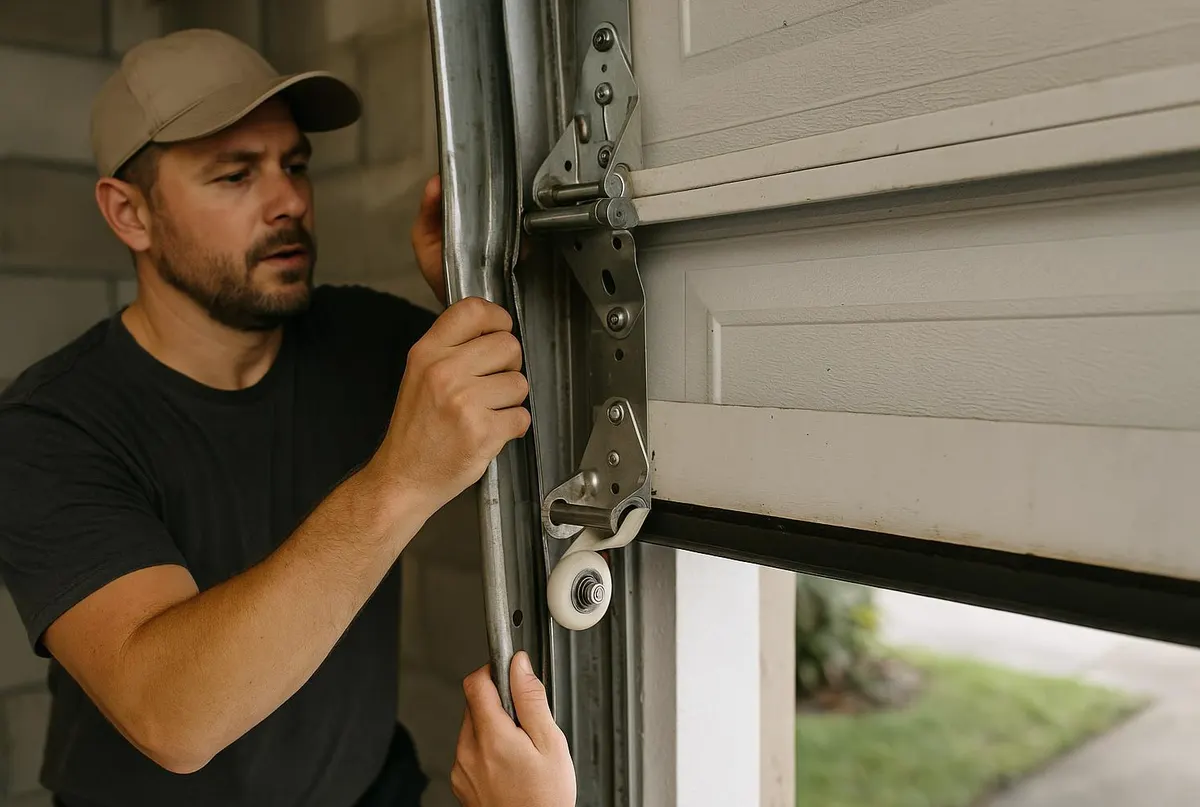
What a Technician Sees After a Windy Night
The calls usually come in the morning after: a homeowner walks out to find one panel bowed inward, the track pulled a few inches away from the wall framing, or rollers popped clean out of their channel. Sometimes the opener's trolley has disconnected from a bent rail, and the door won't budge in either direction. In the worst cases, a door gets shoved off its tracks entirely, left hanging crooked in the opening. Almost every time, the homeowner says the same thing: 'It was fine until the wind picked up.'
Why the Garage Door Is the Weakest Point in the House
A garage door is the largest moving opening in most homes, often sixteen to eighteen feet wide on a double-car garage. That's a lot of surface area for wind to push against, and unlike a solid wall, a garage door is built from thin panels connected by hinges, rollers, and a track system fastened to wood or metal jambs. When wind loads it, the force concentrates on those connection points rather than spreading evenly the way it would across a framed wall.
This matters more than people think. Once a garage door fails during high wind, air rushes into the garage and pressurizes the whole structure from the inside. That pressure can push against the roof deck and walls, which is a big part of why engineers treat the garage door as the weak link in a home's wind resistance. A door that looks fine on a calm day can still be marginal once gusts climb into damaging territory, especially if it was never rated for wind in the first place.
How Local Weather Works Against an Already Vulnerable Door
Fall in this part of Tennessee often brings the remnants of tropical systems pushing inland, which means sustained wind plus gusts arriving together with heavy, wind-driven rain. That combination finds every weak spot at once. Water gets forced under a worn bottom seal while the wind is simultaneously stressing the track hardware. Add in humidity and moisture around pine-shaded garages, and wood jambs that hold the track brackets can soften or rot over time, which means the bolts holding your door's structure have less to grip into exactly when wind loads are highest.
A Practical Pre-Storm Checklist
- Check track mounting hardware. Grab the track with both hands and try to move it. Any wobble means the lag screws or brackets need tightening or replacing before they fail under load.
- Inspect the jamb for soft or discolored wood. Press a screwdriver into the wood around the track brackets. If it sinks in easily, moisture has gotten in and the mounting point needs reinforcement or replacement.
- Replace cracked or flattened weatherstripping. The bottom seal and side seals are your first line of defense against wind-driven rain; brittle or torn seals let water pour in under pressure.
- Add or check horizontal struts. These reinforcement bars run across the back of each panel and are often the difference between a door that flexes and one that buckles under wind pressure. Many standard doors only have a strut on the top panel, which isn't always enough.
- Test the opener's manual release and battery backup. If the power goes out mid-storm, you want to be able to close or secure the door by hand without a fight.
- Clear gutters and downspouts near the garage. Pooling water against the slab works its way under the door faster than most people expect.
- Trim back pine limbs that overhang the garage roofline or opener's exterior wiring, since storm winds turn loose branches into real hazards.
During and After the Storm
Keep the door closed through the event and avoid parking a vehicle in a spot that blocks the manual release handle, in case you need it. If the door is damaged while the storm is still active, don't try to force the opener. Afterward, walk the door's full range by hand before using the opener again. Look for bowed panels, separated tracks, or water stains along the bottom seal. A door that cycles with grinding or resistance after a storm has usually taken some structural hit, even if it closes.
When to Call Crossville Garage Door Pro
If your inspection turns up loose track hardware, soft jamb wood, or a door that's starting to show its age before storm season hits, our Garage Door Maintenance service covers exactly this kind of reinforcement and tune-up work. If a storm has already done damage, our Emergency Garage Door Service gets a technician out to assess and secure the door before more wind or rain gets in. We work throughout Crossville, Cookeville, Fairfield Glade, Sparta, Monterey, Rockwood, Spring City, and Pikeville.
Don't wait for the next system to roll through to find out your door isn't ready. Call Crossville Garage Door Pro today to get your garage door storm-ready before the wind picks up.